
What Color Eyes Will My Baby Have? Chart & Odds
No one can tell you the exact color. Eye color comes from many genes working together, not a single on/off switch, so the honest answer is a probability rather than a promise.
What you can do is get the real odds. Two brown-eyed parents usually have a brown-eyed child, yet a blue-eyed baby is still possible. Below is a chart for every parent combination, the reason the surprises happen, and a calculator that runs the math for your own family.
The short answer: can you predict a baby's eye color?
You can predict probabilities. You cannot predict the exact shade. Brown is the most common outcome on the planet, so it's the safe bet for most couples — but "most couples" is not "you."
The one-gene story from school biology is wrong. At least 16 genes shape eye color, and two of them, OCA2 and HERC2, do most of the heavy lifting. That's why a proper baby eye color chart gives percentages and never a guarantee. If a site promises to name the color for certain, close the tab.
How eye color is inherited
Dominant and recessive: brown, green, blue
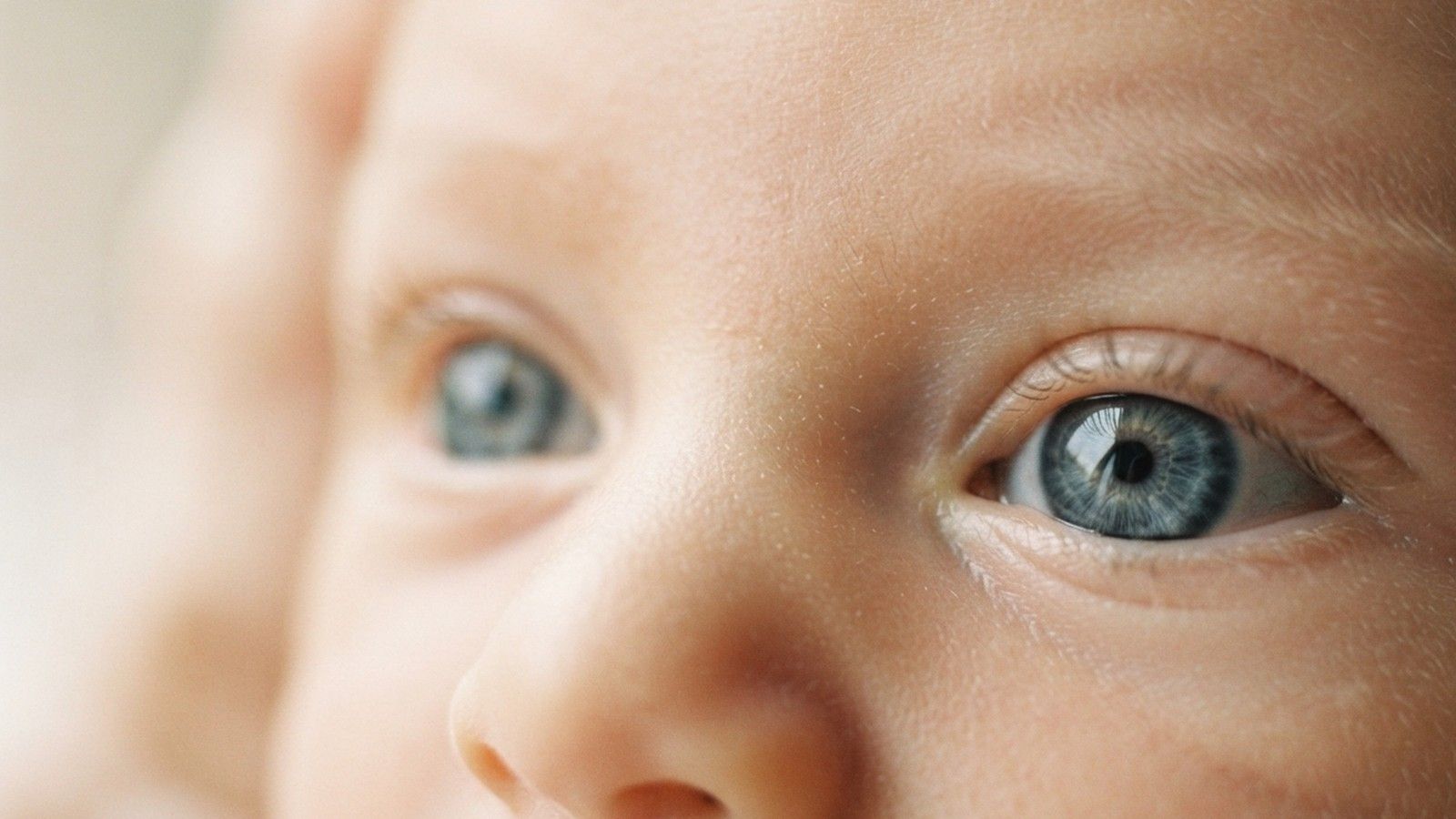
Melanin in the iris sets the color. A lot of melanin reads as brown. Very little reads as blue. The in-between amounts give you green and hazel.
Brown versions of the genes tend to win over green, and green tends to win over blue. So brown shows up in most match-ups, and blue only appears when a child inherits the low-melanin versions from both sides at once. This is the "brown beats green beats blue" rule of thumb — useful, but it's a cartoon of the real thing.
Why eye color is polygenic (not one single gene)
Here's the part the simple rule leaves out. Several genes each nudge melanin up or down a notch, and the total is what your eye reflects back. Because the outcome is a sum of many small effects, the neat 25%/50%/75% figures are approximations, not laws.
Two blue-eyed parents almost always have a blue-eyed child. "Almost" is the accurate word, and it's doing real work — rare brown-eyed exceptions have been documented. Polygenic means surprises are baked in.
Baby eye color chart: odds by parent combination
Here's the standard chart most calculators run on, based on the eye color genetics summarized by AllAboutVision. Find the row that matches you and your partner:
| Parents' eye colors | Brown | Green | Blue |
|---|---|---|---|
| Brown + Brown | 75% | 18.75% | 6.25% |
| Brown + Green | 50% | 37.5% | 12.5% |
| Brown + Blue | 50% | 0% | 50% |
| Green + Green | 1% | 75% | 24% |
| Green + Blue | 0% | 50% | 50% |
| Blue + Blue | 1% | 1% | 99% |
Read a 0% as "very unlikely," not "impossible." These are estimates from a simplified three-color model, and real inheritance is polygenic, so the edges stay a little fuzzy. The chart also skips hazel to stay readable — for hazel and grandparents, the calculator below handles it.
Where do hazel and grey eyes fit in?
Hazel and grey don't get their own column in most charts, and there's a reason. They're the hardest to pin down. Hazel is a brown-green mix that shifts with the light, sitting between the two on the melanin scale instead of being a clean category. Grey is essentially blue with even less melanin and a bit of extra scattering.
Because they're in-between shades, no simple table predicts them well. They lean toward their nearest neighbor — hazel toward brown or green, grey toward blue. The calculator treats hazel as its own outcome using that lean, which is an estimate rather than settled science. If a parent has hazel eyes, expect a spread of brown, green, and hazel odds rather than one clear winner.
Can two blue-eyed parents have a brown-eyed baby?
Yes, but rarely. Blue-eyed parents carry mostly low-melanin genes, which is why a brown-eyed child is such a long shot for them — the odds sit near 1%. It isn't zero, though, and that's the polygenic system leaving a small door open. Documented cases exist.
The reverse is far more common. Two brown-eyed parents having a blue-eyed baby happens any time both of them quietly carry a blue version of the gene. Neither shows it, both pass it on, and about one child in four turns up blue. A blue-eyed grandparent is your tell that the hidden gene is in the family.
Predict your baby's eye color
Working a chart by hand gets fiddly the moment you add hazel eyes or want grandparents in the mix. That's what the tool is for. Our baby eye color calculator takes the eye colors of both parents — and all four grandparents, if you know them — and returns the odds for brown, hazel, green, and blue.
Grandparents are worth the extra clicks. They expose the recessive genes a parent carries but doesn't show, which is exactly the information that turns a rough guess into a sharper one. A brown-eyed mom with a blue-eyed father is a different bet than a brown-eyed mom whose whole family is brown-eyed.
When does a baby's eye color stop changing?
Most newborns arrive with dark grey-blue eyes because melanin hasn't built up yet. Over the first year, melanin production ramps up and the true color surfaces.
By roughly 9 to 12 months you'll usually see the near-final shade. Small shifts can still creep in up to about age 3, and green or hazel eyes tend to take the longest to settle. So don't get attached to those newborn blues — more often than not, they change.
Does eye color affect your baby's vision?
Color and eyesight are separate. A blue-eyed baby doesn't see any worse than a brown-eyed one. The only real difference is light: less melanin means less built-in filtering, so lighter eyes can be a touch more sensitive to bright sun. It's minor, and a hat or baby sunglasses handle it. Nothing about eye color changes how well your child sees.
Beyond eye color: see your baby's whole face
Eye color is one trait out of hundreds. If you're curious what the whole face might look like — eyes, nose, hair, the blend of both parents — our AI Baby Generator builds a photo prediction from two parent photos in about a minute. Think of it as the visual version of the guessing you're already doing with the chart.
Want to go wider on the genetics first? Our take on what will my baby look like and the breakdown of how genes are passed from parents cover the rest of the picture.
FAQ
What color eyes will my baby have?
Most likely brown, since brown tends to dominate and it's the most common color worldwide. Your real odds depend on both parents' eye colors and, ideally, their parents' too. Match your combination to the chart above or run it through the calculator.
Can two brown-eyed parents have a blue-eyed baby?
Yes. If both parents carry a hidden blue-eye gene, roughly one child in four can have blue eyes. A blue-eyed grandparent on either side is a strong sign that gene is present.
Do all babies start with blue eyes?
No — that's a myth. Babies with more melanin, common in darker-skinned families, are often born with brown or hazel eyes right away. The "born blue" pattern shows up mostly in lighter-skinned newborns.
When does a baby's eye color become permanent?
Usually between 9 and 12 months, though minor changes can happen up to age 3. Green and hazel eyes are the ones most likely to keep shifting the longest.
How accurate is a baby eye color calculator?
It gives solid probabilities, not certainty. Because eye color is polygenic, every calculator is an educated estimate. Adding grandparents makes it more reliable, but no tool can promise the exact color.