What Will My Baby Look Like? Take Our Fun Genetics Quiz and See AI Predictions
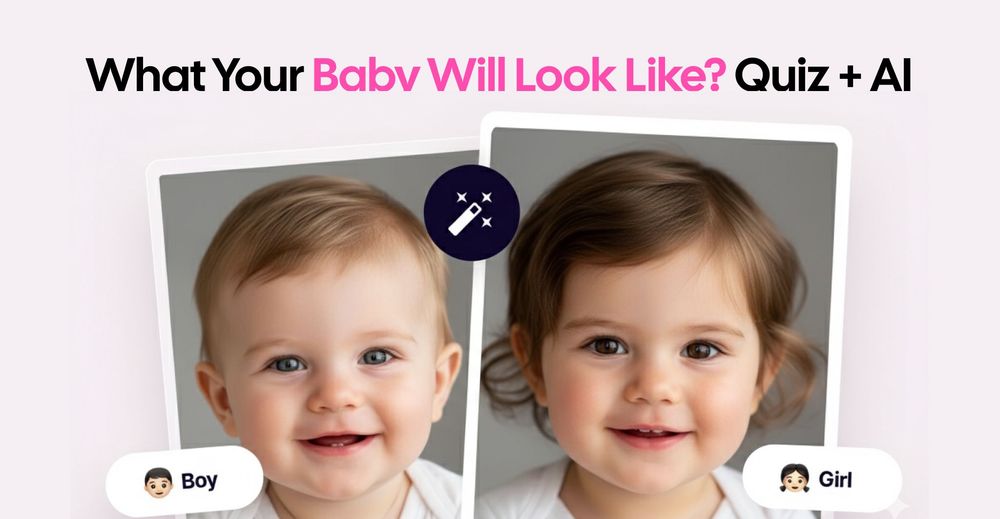
Illustrations are AI-generated
This baby prediction quiz asks eight questions about the two families — eyes, hair, freckles, height, features that repeat — and returns the traits your child is most likely to show. It takes about two minutes and predicts tendencies, not certainties: genetics deals in odds, and a quiz can only read the odds you describe to it.
If parents have reached the point of really wanting to know what their future baby will look like, this page will help predict a child's appearance entertainingly.
Note: Knowing exactly what a baby will look like is impossible, but we'll use the latest research data and proven theories about how genes shape a child's features will lift the veil of mystery.
Our “What will my baby look like” quiz offers entertaining insights into genetic inheritance. While no test guarantees accuracy, understanding family patterns provides fascinating clues about a baby's potential appearance.
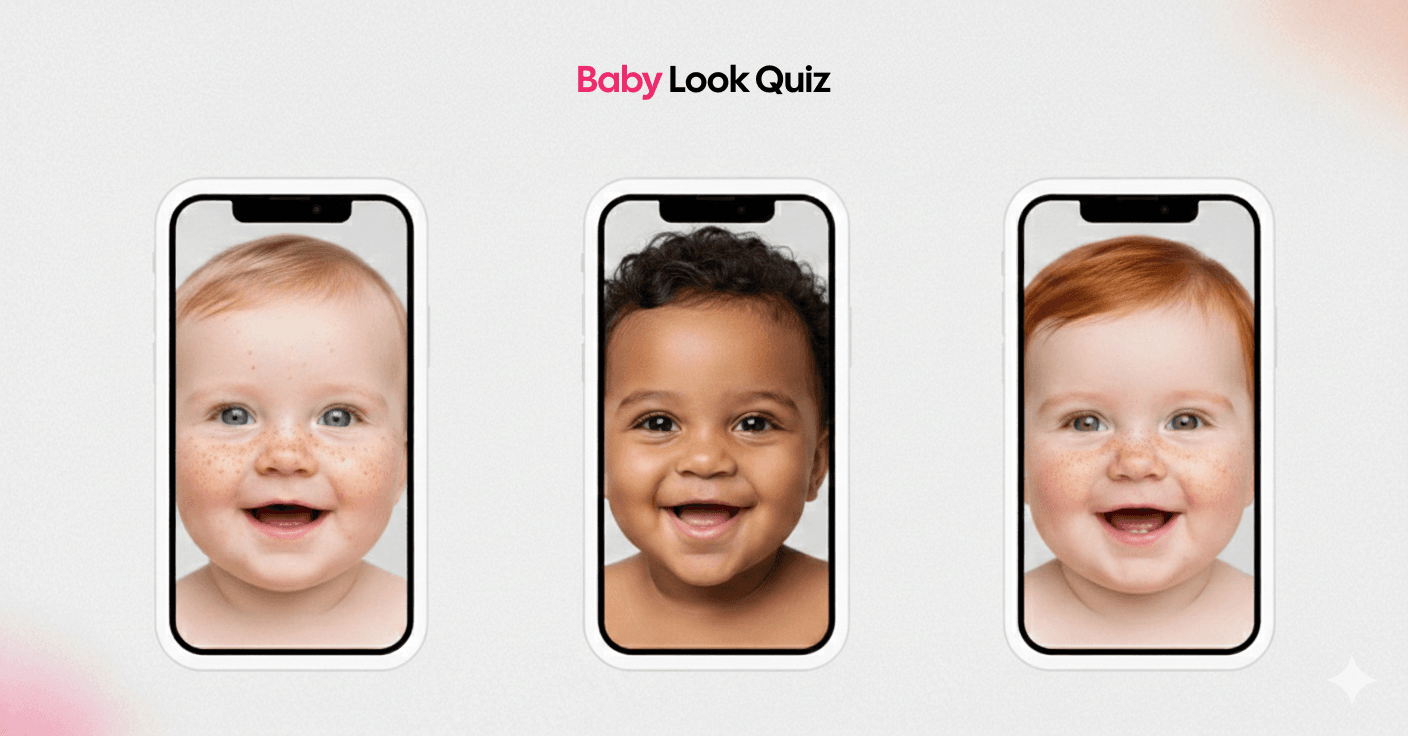
Take the Baby Feature Prediction Quiz
Answer for both families, not only for the two of you. Eight questions, two minutes, and the more you know about the grandparents the more useful the result gets — most surprises in a newborn's face come from a generation back rather than from the parents.
Calculation Instructions (Very Simple):
For each answer A: +1 to Mum (M)
For each answer B: +1 to Dad (P)
For answer C: +1 to M and +1 to P
For answers D/E: 0 points
At the end, compare the sums of M and P. Higher M score indicates more maternal lineage markers. Higher P score suggests more paternal markers. Nearly equal scores (difference 0-2) indicate a mixed variant, which is actually most common.
How my baby will look : Pigmentation (Eyes/Hair/Freckles)
Question 1: Who in the family has dark hair (black/dark brown) more often?
A) More often on the mother's side (mother/her parents/grandparents)
B) More often on the father's side
C) About the same on both sides
D) Almost no one
Question 2: Who has light-colored eyes (blue/grey) more often?
A) On the mother's side
B) On the father's side
C) Both sides equally
D) Neither side
Question 3: Who has brown or very dark eyes more often?
A) On mother's side
B) On father's side
C) Both equally
D) Neither
Question 4: Has anyone shown red or copper hair color and pronounced freckles?
The red-haired phenotype often associates with MC1R genes. This trait can skip a generation entirely.
A) Mother's side
B) Father's side
C) Both sides
D) No one
Question 5: Who shows freckles, very fair skin, or sunburn proneness more often?
A) On mother's side
B) On father's side
C) Both equally
D) Neither side
How my baby will look: Hair Structure
Question 6: Who in the family tends toward curly or very wavy hair?
A) On mother's side
B) On father's side
C) Both sides
D) Neither/straight hair predominates
Question 7: Who has very thick hair or a pronounced "mane" more often?
A) On the mother's side
B) On the father's side
C) Both equally
D) Neither/fine hair is common
How my baby will look : Facial Features (Family "Marks")
This section isn't about "parental dominance" but rather which side consistently repeats certain traits.
Question 8: Who shows a pronounced dimple on the chin or "cleft chin" more often?
A) On mother's side
B) On father's side
C) Both sides
D) Neither
Question 9: Who has dimples on cheeks when smiling?
A) On mother's side
B) On father's side
C) Both sides
D) Neither
In everyday life, people often call this "dominant." In reality, inheriting such traits can be more complicated. We use family recurrence as a guideline, not a guarantee.
Question 10: Which line does nose shape most often resemble?
A) Mother's side
B) Father's side
C) Mixed/varies
D) Cannot determine
How my baby will look: Height and Physique (Polygenic!)
Question 11: In the family, who tends to be "very tall" more often?
A) On mother's side
B) On father's side
C) Both equally
D) Neither/average height predominates
Height is highly hereditary but involves thousands of variants plus environment.
Question 12: Are "short or petite" people more common on one side?
A) Mother's side
B) Father's side
C) Both equally
D) Neither/tall people predominate
Question 13: Who shows a "stocky or prone to weight gain" physique more often?
A) On mother's side
B) On father's side
C) Both equally
D) Neither
Body weight is a multifactorial trait: genes plus diet, activity, and sleep. It's more a family tendency than a predetermined outcome.
How my baby will look : "Forecast Amplifiers"
Question 14: Comparing photos of great-grandmothers and great-grandfathers, whose "type" repeats in subsequent generations more often?
A) The maternal line "copies itself" more often
B) The paternal line "copies itself" more often
C) Both lines produce recognizable repetitions
D) Cannot assess
E) No photos/don't know
Question 15: Were twins born more often in which family?
A) On mother's side
B) On father's side
C) Both equally
D) No twins/don't know
For fraternal twins, family tendency is more visible on the maternal side due to ovulation characteristics. However, this isn't strictly deterministic.
How the Baby Appearance Quiz Works
Each question asks who carries a trait — you, your partner, or someone a generation back. The quiz weighs how often a feature appears on both sides and how dominant it tends to be, then reports the likeliest outcome. Grandparents matter here: a trait that skipped you can still reach your child.
| Trait | What decides it | How well a quiz reads it |
|---|---|---|
| Eye colour | Several genes, mostly two major ones | Good — parent and grandparent colours narrow it quickly |
| Hair colour | Polygenic; red needs both parents to carry it | Fair — a recessive red can surface unpredictably |
| Hair texture | Polygenic, blends rather than switches | Fair — mixed parents usually give something in between |
| Height | Hundreds of variants plus nutrition | Good as a range, useless as a number |
| Dimples, cleft chin | Polygenic, not the single dominant gene of school worksheets | Weak — runs in families, refuses to follow rules |
| Overall resemblance | Face shape from many genes at once | Weak — this is where an AI portrait does better than a questionnaire |
Below is a simple "family genetic" test. It doesn't promise 100% accuracy but logically assesses genetic clues. The quiz evaluates which line (maternal or paternal) shows more markers for external characteristics and traits.
Important Context of What Baby Will look Like
There is no "single dominant gene from one parent" determining a child's entire appearance. Children inherit gene variants from both parents and from the whole family line equally.
What do your quiz results actually mean?
The result names the traits your child is most likely to show and the ones that could go either way. Read it as a ranking rather than a verdict: a trait listed as likely is one both families keep producing, and a trait marked uncertain is one where a single recessive variant can overturn the pattern.
Calculate the scores for M (Mother) and P (Father).
Conclusion: "Whose Line Does the Baby Resemble More?"
M ≥ P + 3: The child will more likely be perceived as resembling the maternal line. This is especially true with many A answers in Blocks 1 and 3 (pigmentation and facial features).
P ≥ M + 3: More likely to be "read" as similar to the paternal line. Strong paternal genetic markers dominate family appearance patterns.
|M − P| ≤ 2: The most realistic scenario is a mixed type. Some features like eyes may go "one way" while height, hair, and facial features go "the other way."
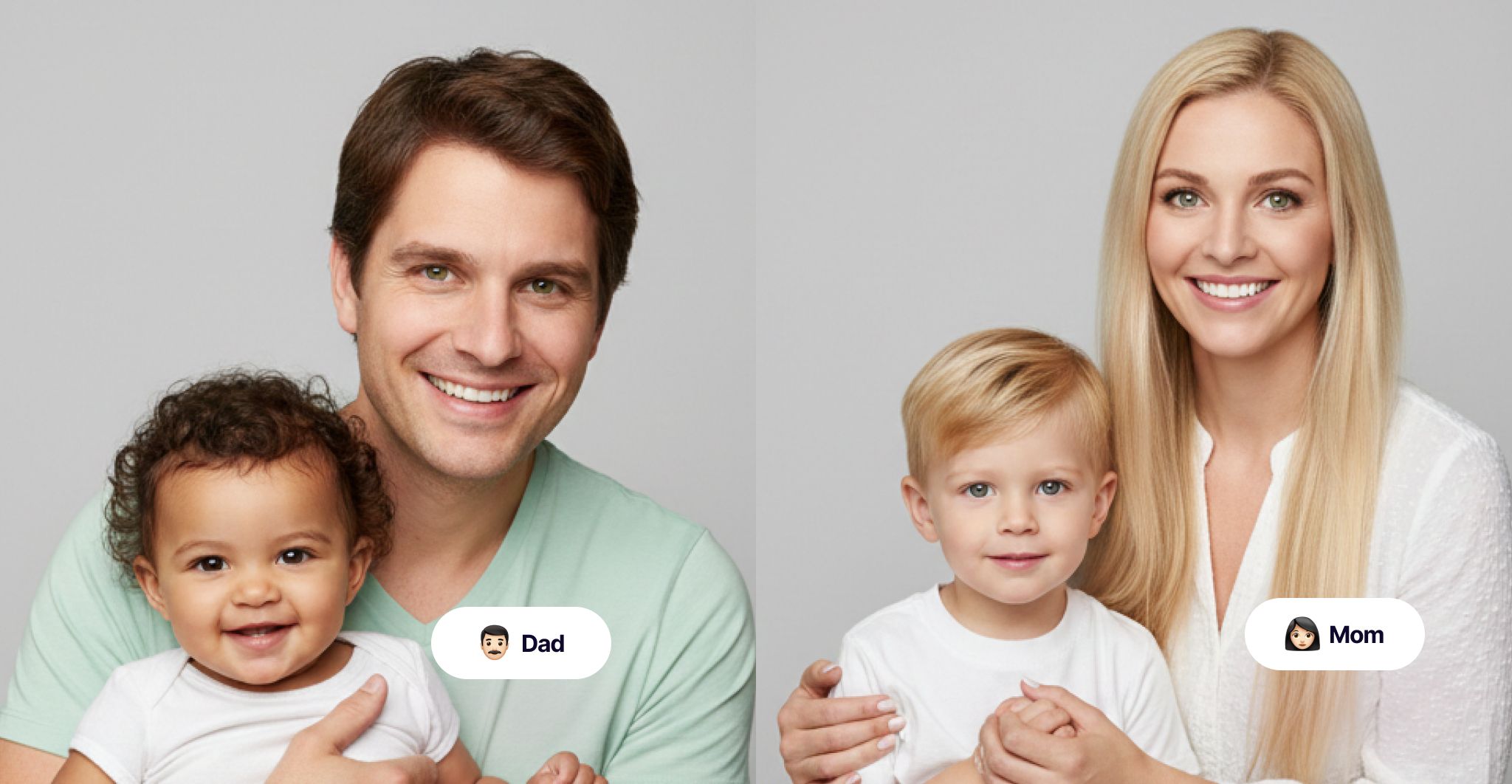
How does the quiz compare with an AI photo?
A questionnaire reads odds; a portrait shows one outcome. The quiz is better at telling you why a trait is likely, an AI image is better at showing what the combination looks like on a face. Neither predicts a specific child, and the ways they miss are different enough that using both tells you more than either alone.
This what will my baby look like quiz provides entertaining estimates based on family patterns. However, it cannot show what the baby will actually look like.
Quizzes rely on probability and genetic generalizations. They assess family trends but cannot account for specific gene combinations. The verbal descriptions they produce require imagination to visualize.
How AI Technology Differs
While quizzes provide fun probability estimates, AI baby generator technology takes prediction to the next level. Instead of guessing percentages, parents can see a realistic visualization of how their baby might actually look.
The technology analyzes actual facial features from uploaded parent photos. It examines more than 50 distinct facial characteristics. These include bone structure, eye spacing, nose shape, lip fullness, and skin tone variations.
Advanced algorithms process genetic probability alongside actual parental features. This creates a visual representation far more concrete than any word-based description.
Why Visual Predictions Are More Comprehensive
A verbal portrait from a quiz might state "brown eyes, dark hair, average height." But what does "average height" mean? How dark is "dark hair"? What shade of brown eyes?
Visual prediction tools eliminate this ambiguity. They show the actual features rather than describing them. Parents see eye shape, not just color. They observe facial structure, not just "oval face."
The AI portrait tool generates images at multiple ages. Parents can view their baby as a newborn, toddler, or teenager. This progression helps visualize how features might develop over time.
Which traits does the quiz cover?
Eight questions cover pigmentation, hair structure, facial features, height and the family patterns that amplify a trait when it appears on both sides. Each answer counts who carries the feature, which is why grandparents are asked about as often as parents.
No method can predict a baby’s appearance with 100% accuracy, but genetics and AI can give fun, surprisingly realistic estimates.
Research into gene dominance exists but has limited bearing on final appearance. Medical advances in this field remain fragmentary. The only current capability humanity possesses is selecting the healthiest embryos, as done by a project Orchid Health.
As for baby appearance and parental gene influence, this mystery remains hidden. It's locked behind the magic. Of course, this baby appearance quiz has no medical validity. It bases conclusions solely on existing human genome inheritance concepts current as of 2026.
Understanding Quiz Limitations
Moreover, describing a person's appearance using words alone is almost impossible. This test shows only what a baby is more inclined to inherit. It focuses on bright, dominant features from both family lines.
Each person will imagine the verbal portrait differently. Visual representation provides much clearer insight into potential outcomes.
For a slightly more immersive but still entertaining version, consider using the future child generation feature. When answering test questions by choosing options A, B, C, D, or E, the result remains a verbal portrait. This format makes visualization quite difficult.
FAQ
How accurate is a baby prediction quiz?
Accurate about tendencies, not about a specific baby. Eye colour and height ranges follow family patterns closely enough to be worth predicting; face shape and dimples do not. Treat the result as the likeliest column of a table, not a photograph.
How long does the quiz take?
About two minutes. Eight questions, and you answer for both families rather than only yourselves — the grandparents are what make the answers useful.
Can a quiz predict eye colour?
Better than most traits. Two brown-eyed parents can still have a blue-eyed child if both carry the variant, which is exactly why the quiz asks about grandparents rather than stopping at the two of you.
Quiz or AI photo — which comes closer?
They answer different questions. The quiz tells you which traits are likely and why; an AI portrait shows one face those traits could produce. Reading the odds and seeing a face are not the same thing, and most people want both.
Final thoughts
When the child is eventually born and grows, comparing generated images to reality often produces surprising accuracy. The technology analyzes more than 50 distinct facial characteristics. This comprehensive analysis captures nuances that verbal descriptions cannot convey.
Whether using quizzes, visual generators, or simply imagining possibilities, the real joy comes when parents finally meet their unique, beautiful baby. That moment of first sight surpasses any prediction, bringing a reality more wonderful than imagination could create.