What Color Hair Will My Baby Have? Genetics & Odds
No one can name the exact shade before your baby arrives. Hair color comes from many genes working together, so the honest answer is a set of odds, not a promise.
What you can do is get those odds. Two dark-haired parents usually have a dark-haired child — yet a blonde or even red-haired baby is still on the table. Below are the likelihoods for common parent combinations, the reason the surprises happen, and where curls and texture come from.
The short answer: can you predict a baby's hair color?
You can predict probabilities, not the precise color. Darker shades tend to win, so brown and black are the safe bets for most couples. But "most couples" is never the same as "you."
The one-gene story from school is wrong. Hair color is polygenic — a stack of genes each nudging two pigments up or down. That's why a real predictor gives percentages and never a guarantee. If a page promises to name the color for certain, close the tab.
How hair color is inherited
Two pigments do all the work
Every baby's hair color is a mix of two pigments:
- Eumelanin — the dark pigment. A lot of it reads as black, less as brown.
- Pheomelanin — the red-yellow pigment. It sets red and strawberry tones and warms up blonde.
Blonde means little eumelanin. Black means a lot of it. Red is high pheomelanin with low eumelanin. Every head of baby hair color sits somewhere on that two-pigment gradient.
Dominant and recessive, roughly
As a rule of thumb, darker beats lighter and non-red beats red:
- Brown and black versions of the genes tend to dominate.
- Blonde is recessive — it usually needs the lighter versions from both parents.
- Red is the odd one out. It runs mostly through the MC1R gene, and almost every redhead carries two red variants — but carrying two is not enough on its own. Among people with two MC1R variants, only about 15% have red hair; most are light brown (41%) or blonde (15%).
This "dark beats light" rule is useful, but it's a cartoon of the real biology. Because many genes each add a small effect, the outcome is a sum — which is exactly why siblings from the same parents can land on different shades.
Baby hair color odds by parent combination
These odds come from our baby hair color calculator, which is calibrated against the hair colors Morgan and colleagues measured in about 343,000 UK Biobank participants rather than a textbook Punnett square. Find the row that fits your family, or run your own combination and add grandparents:
| Parents' hair | Black | Dark brown | Light brown | Blonde | Red |
|---|---|---|---|---|---|
| Black + black | 68.8% | 27.6% | 0.5% | 0% | 3.2% |
| Dark brown + dark brown | 10.7% | 66.1% | 19.5% | 0.5% | 3.2% |
| Light brown + light brown | 0.2% | 20.9% | 58.8% | 16.3% | 3.7% |
| Blonde + blonde | 0% | 0.8% | 23.5% | 71.5% | 4.2% |
| Black + blonde | 2.5% | 49.5% | 41.1% | 3.2% | 3.7% |
| Dark brown + blonde | 0.2% | 20.5% | 58.9% | 16.7% | 3.7% |
| Dark brown + red | 2.4% | 44.9% | 36.0% | 2.7% | 14.0% |
| Red + red | 0.2% | 10.9% | 22.9% | 4.7% | 61.3% |
A 0% in that table means below 0.1%, not impossible — the numbers shift with the exact gene versions each parent carries, which is why two families that "look" the same on paper can get different babies. The frequencies behind them were measured in a white British-ancestry cohort, so read them as a strong baseline rather than a universal one, and as a wider guide to the genetics see MedlinePlus, from the US National Library of Medicine.
Can two brown-haired parents have a blonde baby?
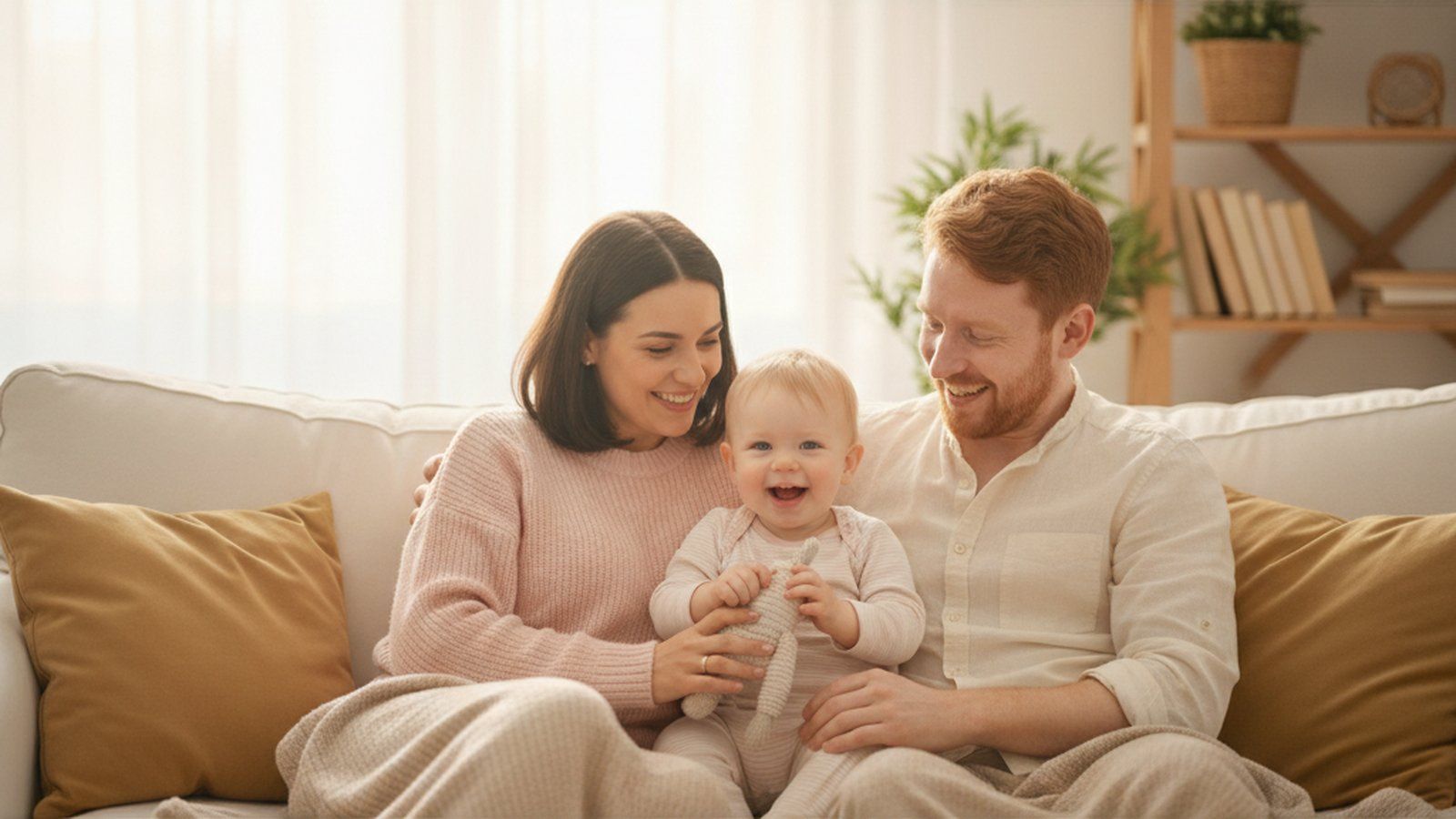
Yes — and it happens often. If both brunette parents quietly carry a blonde variant, their child can inherit blonde from both sides and turn out fair. The parents never showed it because their darker genes covered it up.
The same logic explains a red-haired baby appearing in a family with no obvious redheads: both parents were silent MC1R carriers. Carrying red variants is far commoner than having red hair — most people who carry two of them are light brown or blonde — so red "skips" generations and resurfaces when two carriers meet. A red-haired baby is ordinary genetics, and says nothing about who a child's parents are.
Will my baby have red hair?
Red is the rarest natural color — under 2% of people worldwide, and 4.6% in the UK Biobank cohort behind the table above. About 93% of redheads carry two MC1R variants, so a redhead child usually does inherit a variant from each side. The reverse is where every recessive chart goes wrong: among people carrying two variants, only 15% are redheads, 41% have light brown hair and 15% are blonde. MC1R also explains only about 73% of the inherited variation in red hair, so other genes have a say. What that does to the odds:
- Both parents redheads → the highest chance of any pairing, around 60% — high, but still not the near-certainty a one-gene chart promises, because carrying two strong variants does not always produce red hair.
- One redhead parent → roughly 14–16%, depending on the other parent's shade.
- Two non-red parents → about 3–4%, because quietly carrying the variants is common. This is the classic "surprise" redhead.
Auburn and strawberry tones show up when a child inherits some red pigment alongside more eumelanin — red mixed with brown.
Where do curls come from?
Hair color and hair texture are set by different genes, so they're inherited independently — a blonde child can have tight curls, a dark child can be pin-straight. Texture is also polygenic and leans additive:
- Two curly-haired parents lean toward a curly child.
- Two straight-haired parents lean straight.
- One of each often gives waves — a blend rather than a coin flip.
Texture can also change over the first few years, and again at puberty, as the shape of the hair follicle settles.
When does a baby's hair color settle?
Newborn hair is a poor preview. Many babies are born with fine hair that falls out in the first months, and the color that grows back can be lighter or darker. Hair often keeps shifting through early childhood, and a final darkening is common around puberty.
There is a measured version of that. In a follow-up study of 476 children, 70.8% of those who were blond in early childhood (143 of them) had brown hair by the age of 6–13. So blond baby hair is the least stable starting point there is, and the odds above are for adult hair.
Beyond hair: picturing your baby's whole face
Hair is one trait among many — eyes, skin tone, and facial structure all blend too. You can check the odds for what color eyes your baby will have, or picture the whole face at once: our AI baby generator merges both parents' photos into a lifelike preview in seconds. Treat it as a fun glimpse, not a medical forecast.
FAQ
What color hair will my baby have?
Most likely a shade near the darker of the two parents, because darker pigment tends to dominate. But because hair color is polygenic, lighter and red outcomes are always possible — the honest answer is a probability, not a fixed color.
Can two dark-haired parents have a blonde or red baby?
Yes. If both parents secretly carry a blonde or red variant, the child can inherit it from both sides and show a color neither parent has. This is why fair or red-haired babies appear in dark-haired families.
Is baby hair color from the mom or the dad?
Both, equally. Each parent contributes one copy of every hair-color gene, so the result is a mix. Neither side "wins" by default — the specific variants each parent carries decide the outcome.
Does newborn hair color stay the same?
Often not. First hair frequently sheds and regrows a different shade, and color can keep changing through childhood and puberty. A newborn's hair is not a reliable preview of their adult color.
Are baby hair color predictors accurate?
They give probabilities, not a guaranteed result. The honest ones say where their numbers come from: ours are calibrated so that the colors they predict across many parent pairs add up to the frequencies measured in a large population. Anything built on a single-gene Punnett square will overstate blonde and badly overstate red.