
Will I Have Twins? The Genetics and Odds Explained
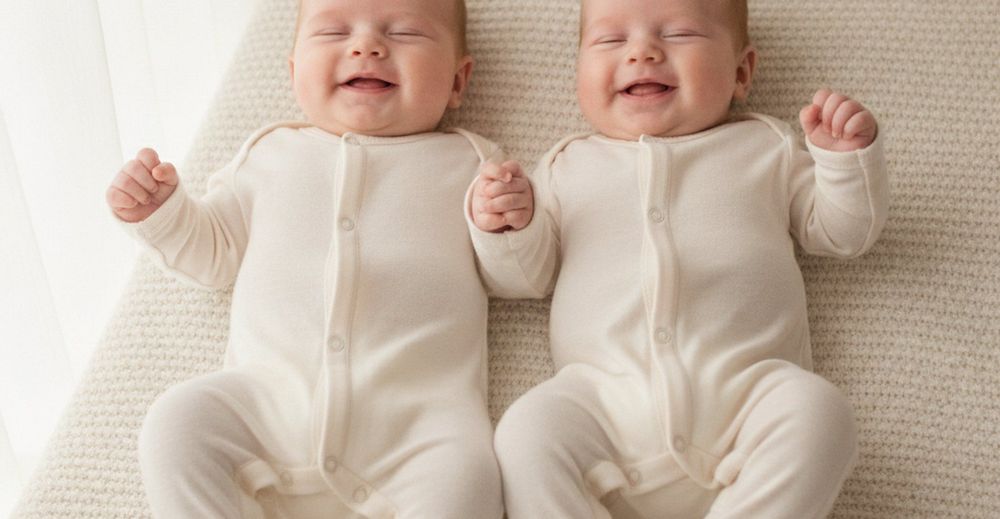
For most people, about 1 pregnancy in 60 is a twin pregnancy — roughly 1.5%. You will often see 3% quoted instead, and that figure answers a different question: it counts twin babies among all babies, so one twin delivery contributes two of them.
Your own odds shift a lot with your genes, your age, and how you conceive. And here's the twist most families miss: only one kind of twin runs in the family.
Below: what raises your odds, how identical and fraternal pairs differ, and how to read the "skips a generation" stories.
The short answer: about 1.5% per pregnancy, but it varies
Roughly 3 in 100 births are twins. That figure has climbed in recent decades, mostly from fertility treatments and later pregnancies. Your own odds can sit well above or below the average, depending on the factors below.
Only one type runs in families, so the answer depends on which kind you mean.
Identical vs. fraternal: the crucial difference
The two types form in completely different ways:
| Identical (monozygotic) | Fraternal (dizygotic) | |
|---|---|---|
| How they form | One egg splits in two | Two eggs, each fertilized |
| Genetics | Same DNA | Siblings who share ~50% |
| Runs in families? | No — appears random | Yes — hyperovulation is heritable |
| Look alike? | Nearly identical | As alike as any siblings |
The headline: fraternal twins can run in the family; identical twins generally don't. Identical twinning happens at about the same rate everywhere and isn't clearly linked to genes.
What raises the odds of fraternal twins
Fraternal twins come from releasing two eggs at once (hyperovulation), and several things make that more likely:
- Family history on the mother's side — a woman who inherits the hyperovulation tendency may release two eggs more often.
- Age — the chance rises into the late 30s as hormone levels shift.
- Previous pregnancies — having had children, especially twins before, raises the odds.
- Height and build — taller and higher-BMI mothers have a modestly higher rate.
- Fertility treatments — IVF and ovulation-stimulating medication are the biggest single factor.
- Ethnicity — rates are highest in parts of Africa and lowest in East Asia.
Want the number for your own case? The twins calculator works out the odds for a single pregnancy from birth-registry rates, and splits identical from fraternal.

Do twins "run in the family"?
Partly. The heritable piece is hyperovulation, and only mothers ovulate — so the tendency matters when it's on the mother's side.
That leads to a common misunderstanding. A father can carry the twin tendency and pass it to his daughter — who may then have a pair herself. So it can look like "skipping a generation." Dad never had twins, but his mother did and his daughter does. He carried the tendency without ever showing it.
Can you increase your chances?
Not safely on your own. The factors that raise the odds — age, genetics, ethnicity — aren't things you'd choose. And doctors advise against trying for them through medication without a medical reason: a twin pregnancy carries higher risks for parent and babies. If it's on your mind for medical or family-planning reasons, talk to your doctor.
Dreaming about two little faces?
Expecting twins, or only imagining them? Our AI baby generator previews a baby from both parents' photos. You can even generate a twins result for double the fun. It's a playful glimpse, not a prediction. Curious what features they might share? See the odds for what color eyes your baby will have.
FAQ
Do twins run in the family?
Fraternal twins can, because the tendency to release two eggs at once is heritable. Identical twins generally don't run in families and appear to happen randomly.
Can twins be inherited from the father's side?
Indirectly. A father can pass the fraternal-twin tendency to his daughter, who may then have twins. He won't have twins himself, which is why they can seem to skip a generation.
What are my chances of having twins?
The baseline is around 1.5% per pregnancy. It rises with a family history of fraternal twins, older age, and previous pregnancies. Greater height or BMI, some ethnic backgrounds, and — above all — fertility treatments push it higher.
What's the difference between identical and fraternal twins?
Identical twins come from one egg that splits and share the same DNA. Fraternal twins come from two separate eggs and are as genetically alike as any siblings.
Do fertility treatments increase the chance of twins?
Yes. IVF and ovulation-stimulating medications are the single biggest reason twin rates have risen. They can lead to more than one egg being fertilized or implanted at once.