
Identical vs Fraternal Twins: The Real Difference
Illustrations are AI-generated
The whole story of identical vs fraternal twins comes down to one fact: how many eggs started the pregnancy. Identical twins, called monozygotic, grow from a single fertilized egg that splits in two, so they carry nearly 100% of the same DNA. Fraternal twins, called dizygotic, grow from two separate eggs, each fertilized by its own sperm, so they share about 50% of their DNA, no more than any other brother or sister.
That one difference shapes everything else: their sex, their faces, their blood type, even the placenta they grow inside. Get that starting point right and the rest of the twin story falls into place.
How each type forms
The split happens at the very start of a pregnancy, and the mechanism is different for each type.
Identical twins: one egg that splits
One sperm fertilizes one egg. A few days later, that early embryo divides into two, and both halves keep the same genetic code. This is why identical twins share a sex and look so much alike. Why the egg splits at all is still a mystery. It seems to happen at random, in roughly 3 to 4 of every 1,000 births, and it does not clearly run in families.
Fraternal twins: two eggs, two sperm
Some cycles release two eggs instead of one. If two different sperm fertilize them, two embryos grow side by side, each with its own genetic mix. That is why fraternal twins can be two boys, two girls, or one of each. They are siblings who happened to share a womb at the same time, no different genetically from brothers and sisters born years apart.
Releasing two eggs, a trait called hyperovulation, can run in families through the mother. That is one reason fraternal twins are the more common of the two types.
Identical vs fraternal twins: a side-by-side comparison
Here is what those two starting points mean in practice.
| Feature | Identical (monozygotic) | Fraternal (dizygotic) |
|---|---|---|
| Eggs and sperm | One egg, one sperm | Two eggs, two sperm |
| Shared DNA | Nearly 100% | About 50% |
| Sex | Almost always the same | Can differ |
| Looks | Strikingly similar | Similar or different |
| Blood type | The same | May differ |
| Placenta and chorion | Can share or separate | Usually separate |
| Frequency | 3 to 4 per 1,000 births | More common |
| Runs in families | No, appears random | Yes, via the mother |
The tricky cases people ask about
Two questions come up more than any others, and the short answers surprise people.
Can identical twins be different sexes?
Almost never. Because they come from one egg, identical twins normally share the same sex chromosomes. The rare exceptions trace back to chromosomal anomalies, such as one twin losing a Y chromosome early on. These cases exist but are vanishingly rare, so a boy and a girl are, for practical purposes, always fraternal.
Can fraternal twins look identical?
Yes, they can look remarkably alike, the way any two siblings sometimes do. Same eyes, same smile, same height. But looking alike is not the same as being genetically identical. Fraternal twins who could pass for copies still share only about half their DNA, so their resemblance is a family likeness, not a genetic match.
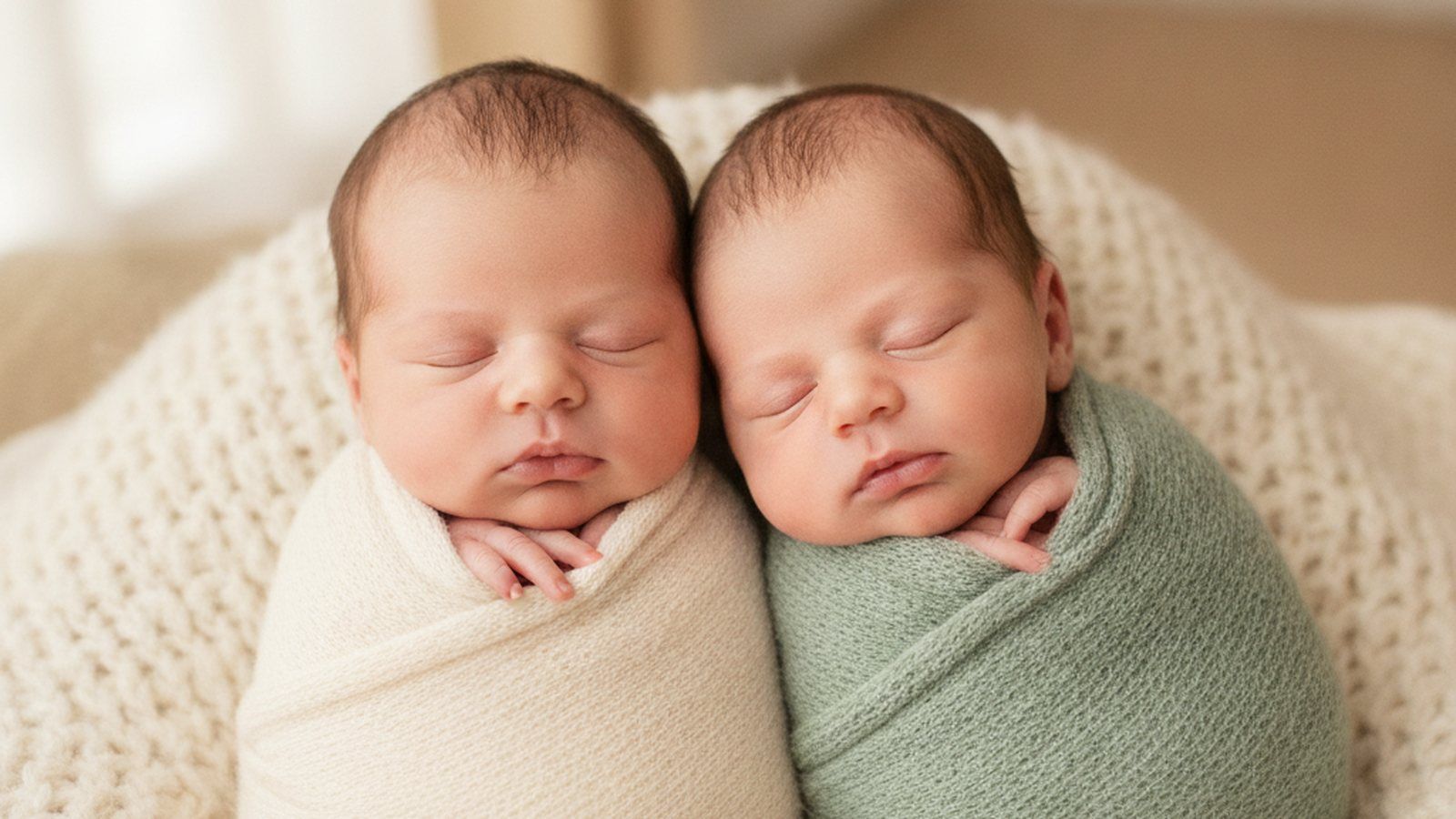
Mirror-image and other subtypes
Sometimes identical twins are described as mirror images. Roughly a quarter of identical pairs develop mirrored features: one is right-handed and the other left-handed, or a birthmark sits on opposite sides. This tends to happen when the egg splits a little later than usual. It is a feature of some identical twins, not a separate type.
Rarer still are conjoined twins, which occur when the split is incomplete. All of these fall under the identical umbrella, since they start from one egg.
How to tell them apart for certain
Parents often want a definite answer, and looks alone will not give one. Two babies can look almost the same and be fraternal, or look a bit different and be identical.
The placenta offers a clue. If the twins clearly shared one inner sac, called the chorion, they are identical. But separate placentas prove nothing, because identical twins can have separate ones too. That is why doctors often cannot settle the question from the birth alone.
The only definitive method is a DNA zygosity test. A simple cheek swab from each twin compares their genetic markers: a near-perfect match means identical, a sibling-level match means fraternal. It is the same logic a paternity test uses, and it removes all doubt.
One more point worth clearing up: twin type is a separate question from your chances of having twins at all. If you are wondering about the odds, our guide on whether you will have twins and the genetics behind it covers that ground.
And if you are already pregnant and watching for the first clues, the symptoms and chances of a twin pregnancy walks through what to look for.
FAQ
Do identical twins have the same fingerprints?
No. They share their DNA, but fingerprints form partly from small movements in the womb, so even identical twins have different prints. The same goes for freckles and other fine details.
Are identical or fraternal twins more common?
Fraternal twins are more common. They also account for most of the rise in twin births linked to fertility treatment and to mothers giving birth later, both of which raise the odds of releasing two eggs.
Can you tell twin type from an ultrasound?
Sometimes, but not always. An early ultrasound can show whether the twins share a chorion, which points to identical. Separate sacs, though, leave the question open, so a firm answer often needs a DNA test after birth.
Do fraternal twins run in families?
The tendency to release two eggs can be inherited through the mother's side, which is why fraternal twins can cluster in families. Identical twins, by contrast, appear to happen at random.
Curious what your own twins might look like before they arrive? You can preview your future babies with our AI baby generator and see two little faces built from you and your partner, whether nature has identical or fraternal twins in store.