
Is Curly Hair Genetic? The Science of Curls, Simply
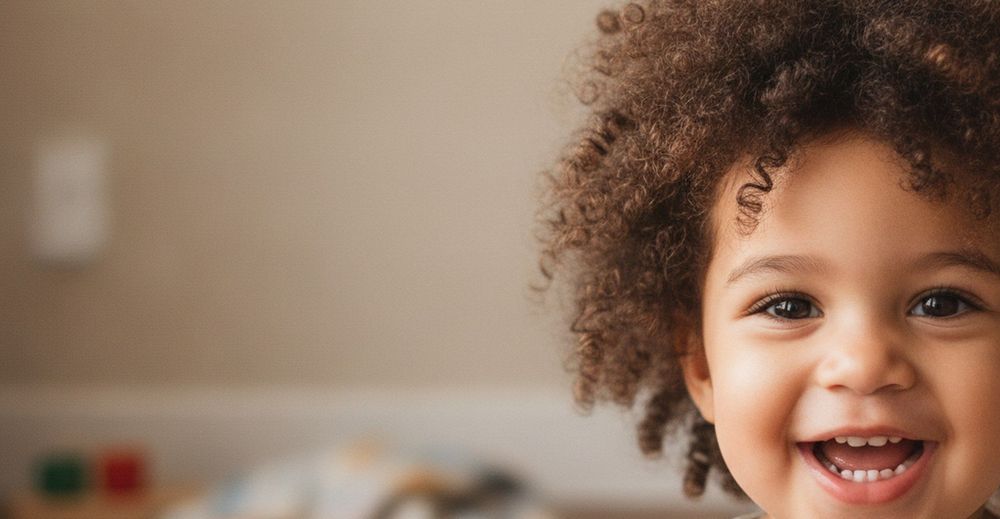
Illustrations are AI-generated
Is curly hair genetic? Mostly, yes. Your curl pattern is largely inherited, but it runs on many genes at once, not one. Hair sits on a spectrum from straight to wavy to curly to coily, and where a person lands is an additive blend of small genetic effects. There is no single "curl gene," and curl behaves as partly dominant rather than a clean on-off trait.
That polygenic setup explains a lot. It is why siblings can differ, why a wavy in-between is so common, and why two straight-haired parents can still get a curly child. Below, we break down curly hair genetics in plain language for curious and expectant parents.
What actually makes hair curly
Curl starts under the skin, in the shape of the hair follicle. A round follicle pushes out a round fiber that grows straight. An oval or asymmetric follicle produces a flattened, uneven fiber that bends as it grows, giving you waves, curls, or tight coils.
The strand you see is just the output. The curl is set by the follicle and by how the fiber is built inside, including how its proteins bond across the hair. Straighten a curly strand with heat and you have not changed the follicle, so the new hair still grows curly.
That is the core idea. Curl is a shape story, written by the follicle, long before the hair reaches the surface.
The genetics: many genes, small effects
Curly hair is polygenic. Dozens of curly hair genes each nudge the outcome a little, and they add up. Some influence hair follicle shape and how it curves. Others affect the structural proteins that build the hair fiber, including trichohyalin-type genes tied to curl in several studies.
No single gene decides the result, so we should not overclaim any one of them. What matters is the total dose of curl-leaning variants a child inherits from both parents. More curl variants, more curl.
This is why curl is clearly heritable and runs in families, yet still unpredictable child to child. It also explains the very common wavy middle ground: a partial blend of straight-leaning and curl-leaning variants lands you between the two.
If hair color raises the same "which genes win" question for you, our guide on what color hair your baby might have walks through that additive logic too.
Is curly hair dominant or recessive?
Neither, cleanly. Curl acts as incompletely dominant and additive, so parents' patterns tend to blend rather than one simply masking the other. Think of it as mixing, not a switch.
That gives rough, real-world patterns:
- One curly parent, one straight parent: children are often wavy, an in-between of the two.
- Two curly parents: children usually lean curly, though the tightness varies.
- Two straight parents: children are usually straight, but a wavy or curly child is still possible.
These are tendencies, not guarantees. Because so many genes contribute, real families throw plenty of surprises.
Can two straight-haired parents have a curly child?
Yes. It is less common, but it happens. Straight-haired parents can each carry hidden curl-leaning variants that never added up to visible curl in them. Pass enough of those to a child and the curl finally shows.
Traits that seem to "skip" or reappear across generations follow this hidden-variant logic. Our explainer on dominant and recessive traits covers how those quiet variants travel through a family tree.

Does baby hair predict adult curl?
Not reliably. Newborn hair is a poor forecaster, because texture often shifts as a child grows. Straight baby hair can turn wavy or curly, and early curls can loosen or drop out entirely.
The biggest changes tend to cluster around two windows: toddlerhood, as the first baby hair is replaced, and puberty, when hormones reshape the follicles. Age and hormones keep editing the pattern well past infancy.
So enjoy whatever your baby arrives with, but hold it loosely. The curls at six months are not a promise about the curls at six years.
A quick, respectful note on hair types
Curl patterns vary widely across populations, from pin-straight to tight coils, and every type is normal and healthy. Genetics simply reflects the ancestry a child inherits. There is no "better" texture, only different follicle shapes doing their thing.
FAQ
Is curly hair dominant or recessive?
Neither in a clean Mendelian sense. Curl is incompletely dominant and polygenic, so a curly parent and a straight parent often have wavy kids rather than strictly curly or strictly straight ones.
Can two straight-haired parents have a curly-haired baby?
Yes. Both parents can carry curl-leaning variants that never showed up as visible curl. If a child inherits enough of them together, curls can appear even when neither parent has them.
Will my baby's curly hair stay curly?
Maybe not. Infant hair texture often changes, especially around toddlerhood and puberty, as follicles mature and hormones shift. Early curls can loosen, and straight baby hair can turn curly later.
What determines hair curl?
Mostly the shape of your hair follicles, set by many genes working together. Round follicles grow straight hair; oval or asymmetric ones grow wavy to coily hair, on a spectrum built from small additive genetic effects.
The short version
Curly hair is largely genetic, but it is a blend, not a coin flip. Many genes shape the follicle, the follicle shapes the curl, and age keeps tweaking the result for years.
Curious how your own curls might carry forward? Preview your future baby's hair with our AI baby generator and see the possibilities.