Celebrity Mashup Baby Prediction: The Safe Way to Do It
Illustrations are AI-generated
Pick a star, pick yourself, and let AI blend the two faces into a "future baby" portrait. It takes about a minute, works from a phone selfie, and it is hard to do only once. The one decision that matters is which celebrity photo you use.
There is one part of this nobody mentions, and it is the part that costs money. The celebrity photo you grabbed from Google belongs to a photographer. Post it and you can get a letter asking for four figures — for one image, on one page, even with no ads on your site.
So here is the whole thing: how to make a celebrity mashup that looks real, which photos are safe to use, and what you can put on your feed afterwards.
Can you make an AI baby with a celebrity?
Yes. A celebrity mashup baby prediction blends two faces into one plausible child portrait, and any face works — yours plus a star, or two stars. AI Baby Generator returns several variations in seconds, with a choice of boy, girl, or twins, at baby, child, or teen age. It is a visual experiment, not genetics.
The appeal is that the result is arguable. A blended portrait sits close enough to both parents that a group chat will spend ten minutes deciding whose nose won. One image turns into a Reel, a Story poll, or a "guess the parents" quiz.
What it is not is a forecast. The model reads visible features — face shape, skin tone, eye and hair colour — and interpolates. Real inheritance runs on hundreds of genes and does not average two faces. Label the result as fun and you avoid the only awkward conversation this hobby produces.
Which celebrity photos are safe to use in an AI baby generator?
Photos you own, licensed stock, and press kit images released for public use. Almost every other celebrity photo online — red carpet shots, paparazzi frames, magazine stills — is owned by an agency like AP, Getty, or Reuters. Feeding one to a generator privately is low risk. Republishing it is what triggers a demand letter.
That distinction is the whole game, and most guides on this topic miss it. The usual advice is to look for "red carpet photos and press photos" because they are sharp and well lit — which points you straight at the most heavily licensed, most heavily monitored category of image on the internet.
Photo agencies run reverse-image crawlers across the web. When one matches, a licensing firm sends a settlement demand. The exposure behind that demand is real under US law: statutory damages for one registered work run from $750 to $30,000 (17 U.S.C. §504(c)), and cropping a photographer's credit off an image is a separate claim carrying $2,500 to $25,000 (17 U.S.C. §1203(c)(3)(B)). Non-commercial does not mean free.
| Photo source | Who owns it | Fine as generator input | Fine to publish |
|---|---|---|---|
| A photo you took yourself | You | Yes | Yes |
| Licensed stock (Getty, Shutterstock, Adobe Stock) | You, under licence | Yes | Yes, within the licence |
| Official press kit / EPK image | Studio, released for press use | Yes | Usually — read the terms |
| Red carpet, event, paparazzi photo | AP, Getty, Reuters, the photographer | Private use only | No |
| A screenshot of someone's Instagram post | The person who posted it | Private use only | No — embed instead |
| An image from Google Images | Someone. Google is not a source | Private use only | No |
Two rules cover the rest. Never crop off a watermark or credit line — that turns one claim into two. And when you want to show a star's own post, use the platform's embed code rather than downloading the file, because an embed points at the original instead of copying it.
How do you make a celebrity mashup baby step by step?
Three steps, under two minutes. Upload two photos, choose the output options, then generate several variations and keep the cleanest one. Most people get a usable result on the second or third try, because the first attempt is almost always a photo problem rather than a model problem.
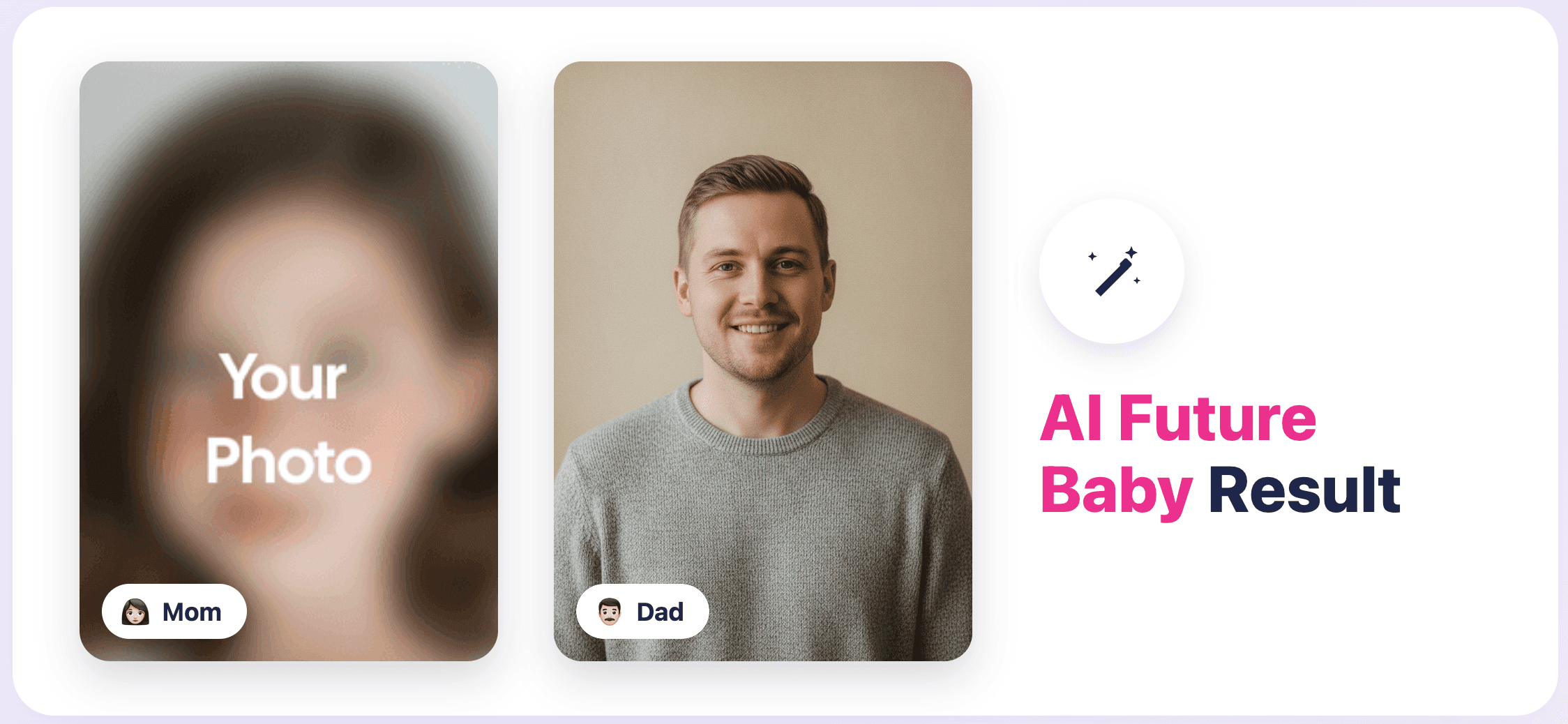
Step 1 — Upload two photos. Drag both in, or tap upload on a phone. Selfies work, old photos work, professional shots work. Use a photo of the celebrity you are allowed to have, per the table above.
Step 2 — Choose the options. Set the gender to boy, girl, or twins. Set the age to baby, child, or teen. Pick a single portrait or a family-style image. The teen setting is the one people underuse and it produces the most convincing "that could be their kid" reactions.
Step 3 — Generate, then compare. Run three or four versions and put them side by side. Small shifts in angle and lighting move the output more than any setting does. Save the sharpest one.
AI Baby Generator is tuned for face blending specifically, so it needs no prompt engineering — a general image model will take you a dozen careful prompts to reach the same place. Free tools on the site need no card at all; AI baby photos run on a 3-day trial for $2.99, then $19.99 a month, cancellable any time.
Why does a celebrity mashup look fake?
Nine times out of ten the cause is the input photo, not the AI. Heavy retouching, a hard flash, sunglasses, or an extreme angle strip out the facial geometry the model needs, so it invents the missing parts. Swap the source photo for a cleaner one and the same generator produces a different class of result.
The checklist that fixes most of it:
- Sharp, high-resolution images — no blurry screenshots
- Front-facing or close to it, on both photos
- Similar lighting in both, natural light being easiest
- No sunglasses, masks, or a hand across the face
- Minimal filters and beauty retouching
- A relaxed expression rather than a big smile
Matching the two photos to each other matters more than either photo being perfect. A soft indoor selfie paired with a harsh studio portrait will blend badly no matter how good each one is on its own. If your results keep landing in the uncanny valley, the longer breakdown of why AI baby photos come out looking off covers the rest.
Which celebrity combinations give the best results?
Pairings with similar face shapes produce the most believable child; opposite face shapes produce the funniest. Naming specific stars dates fast, so think in formats. These are the ones that reliably get a reaction:
Two stars as the parents
- Two actors from the same franchise
- A pop star and an actor
- An athlete and a singer
- A classic icon and a modern star
- Two people with opposite face shapes — the comedy option
- Two people with similar features — the realistic option
You and a star
- Your long-standing celebrity crush
- Your childhood idol
- The lead from the series you rewatch
- An "opposite vibe" pairing — soft and edgy
- A "same vibe" pairing — matched colouring and style
The teen age setting flatters the similar-features pairings, and the baby setting flatters the opposite ones. If you want more of these, the wider list of things to try with an AI baby generator goes past celebrities.
Is it legal to post a celebrity AI baby on Instagram?
Two separate rights apply, and people only ever think about one. The photograph is copyright, owned by whoever took it. The face is a right of publicity, owned by the person. Posting the generated child on a personal account, clearly labelled as fun, sits in low-risk territory. Posting the star's original photo alongside it, or using either to promote something, does not.
Practical version:
- Do not republish the source photo of the celebrity. Post the output.
- Do not use a celebrity mashup to advertise a product, a page, or yourself commercially.
- Do not imply the star endorsed it, or that the child exists.
- Do not upload photos of private people without asking, and be especially careful with children's photos.
- Label it. "Just for fun" costs you nothing and reframes the whole post.
Removing the material afterwards does not erase a claim for the period it was up, which is why the choice of source photo matters before you publish rather than after.
FAQ
Is a celebrity mashup baby prediction accurate or just for fun?
Just for fun. AI Baby Generator blends the visible features of two photos into a plausible portrait — it does not model inheritance, and it cannot. Real traits come from hundreds of genes interacting, not from averaging two faces. Treat the result as a picture, not a prediction.
Can I use two celebrities instead of me plus a celebrity?
Yes, and it is the more popular version. The same photo rules apply to both faces: use images you own or have licensed, keep the source photos out of your post, and publish the generated portrait rather than the originals.
What happens if I use a photo I found on Google?
For a private result you look at once, nothing. Publish it on a public page and an agency's crawler can match it, after which a licensing firm sends a settlement demand — commonly four figures for a single image. Google Images is a search index, not a licence.
Why do results look different every time?
The model resolves ambiguity differently on each run, and small changes in angle, lighting, or expression shift the output further. Generating three or four versions and picking the best is the intended workflow, not a sign something went wrong.
The short version
A celebrity mashup takes two minutes and one decision that matters: where the celebrity photo came from. Use one you own or have licensed, keep it out of the post, publish the generated portrait with a "just for fun" label, and the whole thing stays what it should be — a joke that looks unreasonably convincing.