Baby Filter vs AI Baby Generator: What Each One Shows You
Illustrations are AI-generated
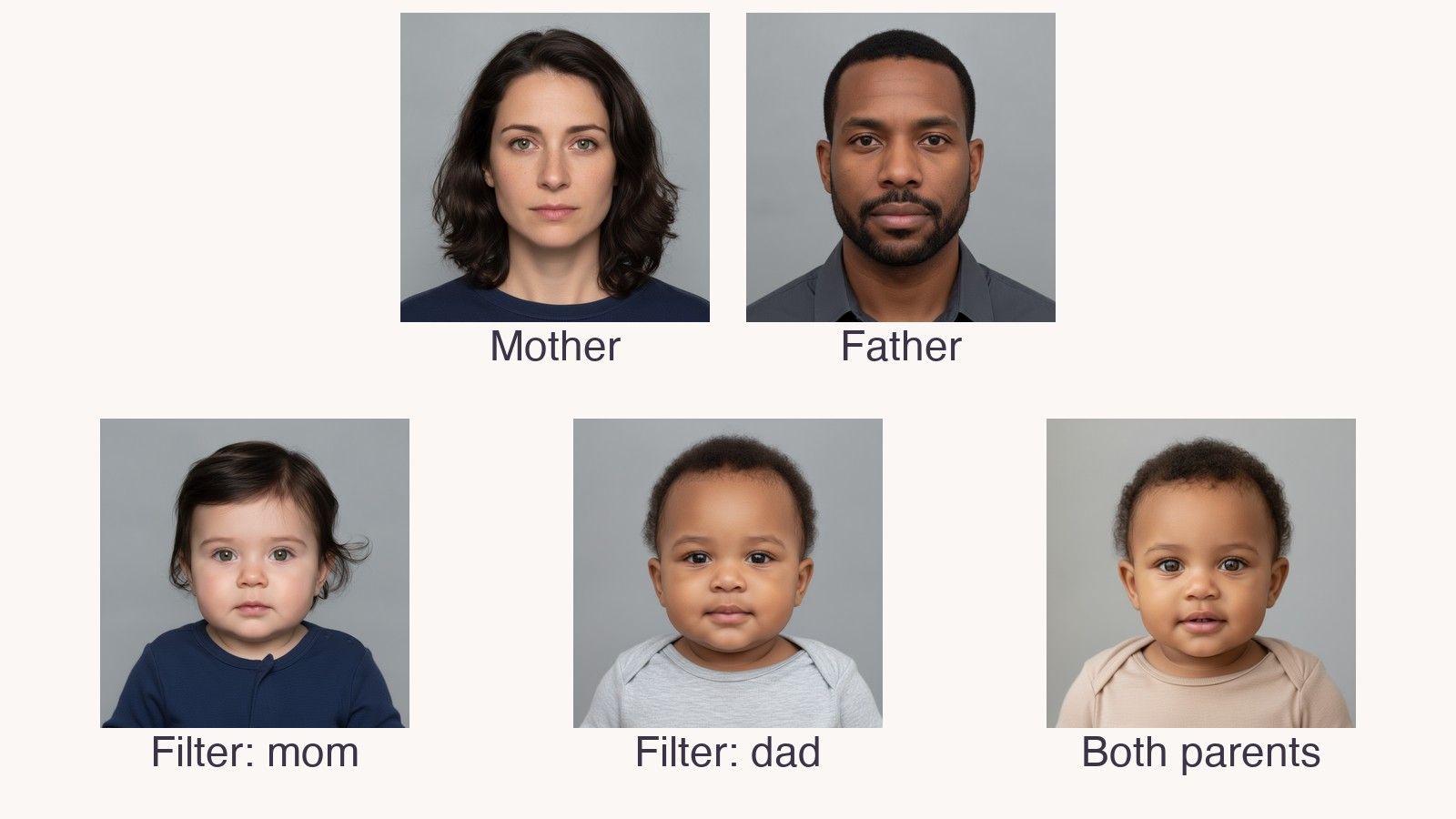
A baby filter shows you as a baby. An AI baby generator shows a child of two people. The two get mixed up because both put a baby face on screen, but they answer different questions. We ran both on the same fictional couple on 20 October 2026, and the difference is plain: the filter returned the mother as a baby, down to her green eyes and her navy top.
If you want a laugh with your own face, a filter is the right tool. If you want to picture a child with your partner, read on.
What does a baby filter actually do?
A baby filter takes one face and makes it look about 1 or 2 years old. It enlarges the eyes, rounds the cheeks, shrinks the nose and chin, and keeps everything else that makes the face yours. Snapchat's Baby lens does this live on the camera; web tools sold as an "AI baby filter" do it from an uploaded selfie.
Two kinds are common:
- Live lenses on Snapchat and TikTok redraw your face on every frame, so you can talk and move as a baby in a video.
- Photo filters in apps and on websites rework a single selfie and give back one still image.
Both start from one face. Nothing in a baby filter asks who the other parent is, and that one fact decides what it can and cannot show you.
What did a baby filter and a two-parent generator give us for the same couple?
We gave the same couple to both methods on 20 October 2026. The baby-filter treatment of each parent returned that parent as a toddler, with the same eyes, hair and clothes. The two-parent generator returned a new child who carried traits from both. The parents were fictional portraits we generated first, so no real person's face was used.
We made all three images in this test with Gemini's image model, gemini-2.5-flash-image, prompting it to behave like a baby filter for one run and like a two-parent generator for the other. That is a simulation, not Snapchat itself, but it isolates the one variable that matters: how many faces go in.
| What went in | What came out |
|---|---|
| The mother's photo, "baby filter" prompt | A baby with her green eyes, her dark wavy hair and her navy top |
| The father's photo, "baby filter" prompt | A baby with his dark eyes, his short curls and his grey shirt |
| Both photos, "baby of these two parents" prompt | A new baby with loose dark curls, brown eyes and a skin tone between the two |
The filter results look convincing, which is exactly the trap. A baby that looks like one parent feels like a prediction, but it is that parent's own childhood face, guessed.
Can a baby filter show what your future child will look like?
A baby filter cannot show your future child, because a child inherits from two people and a filter only sees one. At best it shows a guess at what you looked like as a baby. Children often resemble one parent more than the other, but they still carry the other parent's genes for eye colour, hair and face shape.
Running the filter on both partners and comparing the two babies is a fun game. It still gives you two separate childhood faces, not one child who could be yours together.
For a picture of a shared child, you need a tool that takes two photos. That can be an AI baby generator, or a chatbot like Gemini or ChatGPT with the right instructions. Our tested AI baby prompts for Gemini and ChatGPT show the wording that works and the one that returned an adult.
What is Snapchat's "Our Baby" lens?
"Our Baby" is a lens Snapchat lists under its own name in its lens directory, tagged "baby child", "camera roll" and "face swap". The tags suggest it pulls a second face from your photos rather than working from yours alone. Snapchat's lens page does not explain how the two faces are combined, and we could not test it outside the app.
So treat it the way you would treat any lens: something to try with a partner for fun. If you open it, check whether it asks you for a second photo. A lens that uses only your camera is a baby filter, whatever its name says.
Snapchat's plain Baby lens sits next to it in the same directory, and it is the classic single-face version.
When is a baby filter the better choice?
A baby filter is the better choice when the point is your own face: a funny video, a "me as a baby" post, or a throwback next to a real childhood photo. Snapchat's lenses are free inside the app, and they work on video, which no two-parent generator does in real time.
Filters also need nothing from anyone else. You do not need a partner's photo, and you do not upload a second person's face anywhere.
When should you use an AI baby generator instead?
Use an AI baby generator when you want to picture a child with a specific person. On AI Baby Generator you upload one clear photo of each parent, choose the baby's gender and age, and get a baby photo in seconds. AI Baby Generator deletes uploaded photos within 30 days.
A few honest limits apply. The result is a likeness for fun, not a genetic prediction, and siblings from the same two parents can look very different from each other. Photo quality matters more than anything else: a dark selfie or a side angle gives the model less to blend. If a result looks off, the usual causes and fixes are in why your AI baby photo looks off.
| Baby filter | AI baby generator | |
|---|---|---|
| Faces it uses | One | Two |
| What it shows | You as a baby | A child of two people |
| Works on live video | Yes, in Snapchat and TikTok | No |
| Typical cost | Free in social apps | Paid, starting with a 3-day trial |
| Best for | Jokes, videos, throwbacks | Picturing a child with a partner |
Want to see a child of you and your partner rather than a baby version of yourself? Try the AI Baby Generator with one photo of each of you.
Is it safe to upload a selfie to a baby filter website?
Uploading a selfie to a baby filter website is as safe as that website's photo policy, so read it before you upload. Look for how long the photo is stored and whether it is used to train models. A live lens inside Snapchat or TikTok follows that app's own privacy settings.
Be more careful with someone else's face. Ask your partner before you upload their photo anywhere, filter or generator. AI Baby Generator uses uploaded photos only to make the result and deletes them within 30 days.